
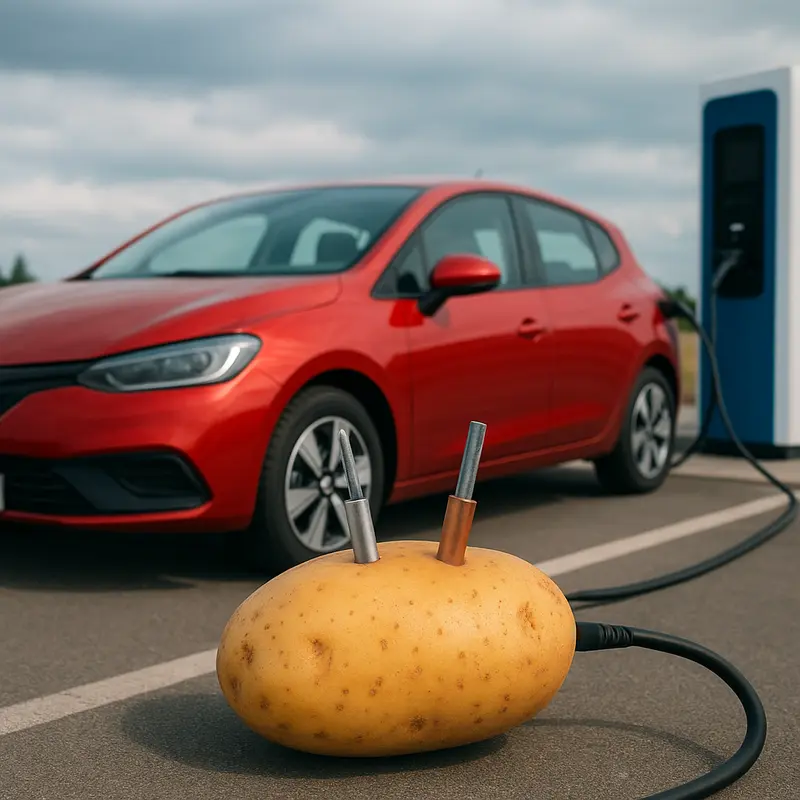
Potato battery as fuel for electric cars in Belarus: myth, mechanics and realistic alternatives
Talk of powering an electric car with a "potato battery" makes for great headlines, but separating novelty from practicality is essential. Small electrochemical cells built from a potato and two dissimilar metals can produce a measurable voltage, and they’re valuable educational tools. However, when evaluated against automotive energy needs and industrial realities, the idea does not scale as a viable primary fuel.
Why a potato cell can't replace a battery pack
Electrified vehicles require tens of kilowatt-hours to travel typical distances (roughly 15–25 kWh per 100 km for modern passenger EVs). Potato-based galvanic cells generate very small voltages and currents—useful for LEDs, clocks or classroom experiments, but orders of magnitude lower in energy density than automotive lithium-ion packs. In practical terms, you'd need an astronomically large mass of potatoes and an impractical array of electrodes to approach useful power levels.
Where the confusion comes from
Many demonstrations conflate “producing voltage” with “producing useful energy.” A potato cell can produce voltage, but continuous power and usable energy capacity are the limiting factors. Internal resistance, fast chemical depletion, perishability and the complexity of connecting many cells in series/parallel make scaling infeasible.
Belarus context — opportunities and constraints
- Belarus grows substantial volumes of root crops and has rural infrastructure that could support pilot projects and circular-economy experiments.
- EV adoption in Belarus faces similar barriers as other transitioning markets: charging infrastructure rollout, grid adaptation, and vehicle cost. Small, portable bio-cells won't address these structural challenges.
Practical, agriculture-linked pathways worth exploring
If the goal is to link potato production to vehicle energy sustainably, consider realistic alternatives with industrial potential:
1) Anaerobic digestion of potato waste: Converting spoilage and processing waste into biogas (methane) is proven and can generate electricity or be upgraded to biomethane for transport.
2) Biomass-to-power microgrids: Local combined heat-and-power (CHP) plants using agricultural residues can support rural charging hubs, reducing grid strain.
3) Bio-derived hydrogen: Research into producing hydrogen from biomass or waste could feed fuel-cell vehicles or seasonal energy storage.
Industry insight and recommendations
Automotive and energy planners should prioritize investments that materially reduce emissions and improve mobility: expanding fast-charging networks, incentivizing battery recycling, and developing waste-to-energy projects linked to agriculture. Universities and innovation labs can still explore potato cells for teaching, low-power sensing, or niche art/marketing campaigns—these projects inspire interest in electrochemistry but must be framed honestly.
In short: a potato battery is a fun demonstration, not a transport fuel. For Belarus, the practical value lies in integrating agricultural waste into realistic energy systems that support EV charging and rural electrification.


