
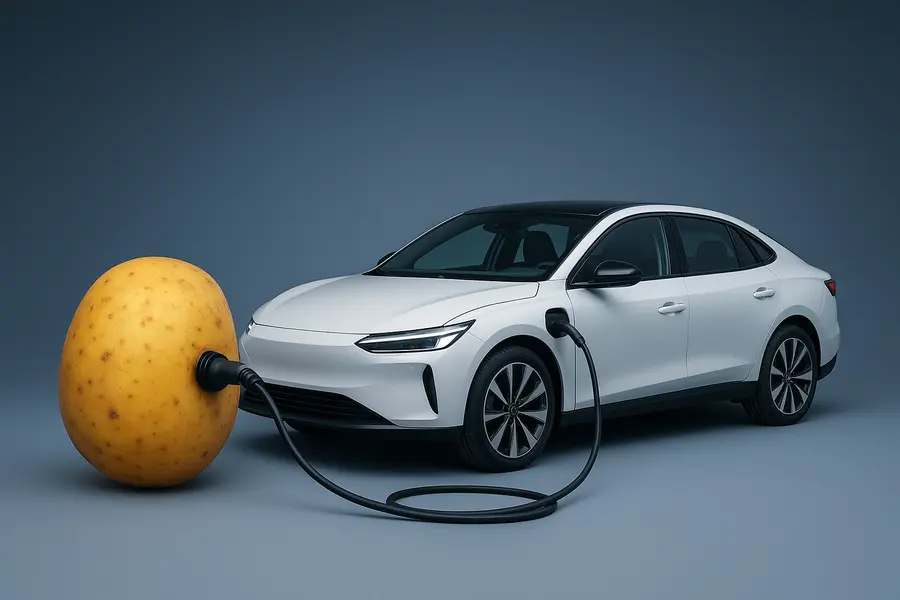
Electric cars powered by potato batteries sounds like a headline hatched at a marketing meeting after too many team-building fry nights. The idea is delightfully tactile: insert zinc and copper electrodes into a tatty spud, harvest a few volts, and watch an EV glide silently down the motorway on starch and sunshine. Charming, but scientifically whimsical.
At heart, a potato battery is an electrochemical cell. The potato’s electrolytes enable ions to flow between dissimilar metals and produce a small voltage. That’s perfect for classroom demonstrations or powering a tiny LED, but orders of magnitude away from moving a two-ton vehicle. Modern electric vehicles rely on lithium-ion or advanced solid-state packs that deliver hundreds of watt-hours per kilogram and massive peak power for acceleration. A single potato’s output lives in the realm of millivolts and milliamps—useful for teaching, useless for highway cruising.
Energy-density math is merciless. An EV with a 60 kWh pack needs tens of millions of times more usable energy than a handful of vegetable cells can provide. Even stacking potatoes would be impractical: space, wiring complexity, degradation, and replacement logistics quickly erase the novelty. Range anxiety would be replaced by grocery-run anxiety.
That said, the potato-battery story is useful for two things the industry values: education and PR. Hands-on demos convert abstract chemistry and energy-storage principles into something people remember. A potato-powered dashboard clock on display at an auto show is a clever way to lead into conversations about battery chemistry, recycling, and the real roadmap toward greener mobility.
More meaningfully, the broader concept of biological or bio-hybrid energy isn’t pure fantasy. Researchers are exploring enzymatic fuel cells, microbial fuel cells, and organic batteries that use biological materials or processes to generate electricity. These technologies aim at niche applications—low-power sensors, remote monitoring, or biodegradable single-use devices—rather than replacing traction batteries. The auto industry watches such research for potential auxiliary systems and for lessons in sustainability and materials sourcing.
From a business perspective, automakers will continue prioritizing dense, fast-charging chemistries, battery recycling infrastructure, and supply-chain resilience for critical elements like lithium, nickel, and cobalt. Bio-based power remains a curiosity with occasional practical offshoots, not a roadmap to spud-powered commutes.
So the potato stays on the plate, and the EV stays on lithium—for now. The myth of tuber-powered transport makes a delightful soundbite, teaches basic electrochemistry, and inspires creative thinking. Real-world decarbonization, however, will be won with higher-energy chemistries, smarter grids, and systems thinking—plus a little less starch in the fuel tank.
If you have any questions or would like help exploring your options, I’d be happy to help. Feel free to reach out anytime for more information or to take the next step when you’re ready.
The Emperor of Mans
(806) 738-21290
Build-A-Brand Motors


